Shida Kartli lies almost in the center of the map of Georgia, and most often it is passed through - on the road from Tbilisi to the west. In vain: here is a Bronze Age cave city, a 7th century temple with frescoes, an independent wine-growing region with its own varieties, a valley with sixty historical sites and a forest lake, which is three kilometers away on foot.
Gori is located 80 kilometers from Tbilisi, so one day is enough for a first acquaintance. For a normal trip it is better to budget two or three.
What is included in the region
Administratively, these are the municipalities of Gori, Kaspi, Kareli and Khashuri with the center in Gori. According to the final data of the 2024 census, about 42% of the population lives in cities and 58% in villages—beyond Gori the territory begins to be mostly rural.
The region stretches between the Caucasian, Likhsky, Trialeti and Kharulsky ranges, the heights vary from approximately 800 to 2200 meters. Hence the simple principle: Shida Kartli is not only Gori.
Burn
The city stands on the Kura and is known primarily as the birthplace of Stalin. But to reduce Gori to just one museum is to get a rather one-sided picture.
Gori Fortressrises on a rocky hill almost in the center of the city. The current fortifications are mainly medieval and later, but archeology indicates a much older occupation of the hill; The fortress was destroyed and rebuilt more than once. It’s worth the climb if only for the panorama: you can see the city, the Kura Valley and the ridges around from above.Stalin Museumis the most famous object in the city and quite specific. The complex includes an exhibition, the house where Stalin spent his early years, and his railway carriage. For the traveler, this is, first of all, an opportunity to see how the difficult Soviet period is represented in Georgia, and not an ordinary biographical museum. If the history of the 20th century is not of interest, the fortress, Uplistsikhe and Ateni should be given higher priority.The Historical and Ethnographic Museum, founded in 1935, is useful precisely as an addition to the fortress: after it, the archaeological sites of the region are perceived differently.
Uplistsikhe
If you're short on time, this is a place you should definitely include. The ancient city is carved into the rocks about 10 kilometers from Gori. A settlement existed here back in the Late Bronze Age, and later Uplistsikhe became an important religious and political center. Since 2006, it has the status of an immovable monument of national importance.
Preserved are rooms carved into the rock, streets and squares, religious buildings, wine presses and wine rooms, a tunnel to the Kura River and the remains of defensive structures.
It is the wine-making facilities inside the cave city that clearly remind us that the history of Georgian wine is noticeably older than the tourism industry.Practical point:This is not a walk through a museum, but rather a rock archaeological site with uneven surfaces, stairs and open areas. Shoes are more important than the photography angle here.
Ateni: wine, temple and waterfall
About 10 kilometers from Gori the Aten Valley begins. The Tana River runs through it and flows into the Kura, and all around are vineyards, ancient settlements, churches, fortresses and nature trails.Atensky Zion- a temple of the 7th century, famous for its architecture and medieval frescoes; Inscriptions from the 9th–11th centuries have also been preserved inside. The church stands on a hill among terraced vineyards.Biisi Waterfall.If you want to move after the temple, a walking trail about 2.5 kilometers long leads from the valley. In winter, the waterfall freezes and turns into an ice column. A good “half-day in nature” format: without a multi-day hike, but with a real walk instead of another trip from monument to monument.
Kartli wine is not Kakheti and not an imitation of it
The National Wine Agency identifies Shida, Kvemo and Zemo Kartli as a separate wine-growing zone of Kartli. The vineyards lie in the basins of the Kura and its tributaries Liakhvi and Ksani, at altitudes of approximately 450–700 meters.
Characteristic varieties of the region:Chinuri, Goruli Mtsvane, Tavkveri, Shavkapitoand Saperavi. Separately, the National Wine Agency notesAtenurias a wine with a protected place of origin, produced in Kartli.
This is important for tasting. In Kakheti, it is logical to compare qvevri and European technology on the same variety. Another thing that’s more interesting in Shida Kartli is to try varieties that simply aren’t available in Kakheti. The profile of the region turns out to be completely different.
Kintsvisi and Dzama Valley
A more intimate part of the region, in the municipality of Kareli. According to Georgia Travel, there are up to 60 historical sites in the Dzama Valley: monasteries, churches, fortresses and towers.
The main one is theKintsvis Monastery, associated with the era of Queen Tamar; his frescoes are considered to be outstanding examples of Georgian monumental painting. In the same direction are Mdzovreti, Ortubani, Sarkineti and other complexes.
You shouldn’t go here in the “three main places in four hours” mode. A slow pace works here: staying in a valley, combining architecture with nature.
Bateti Lake
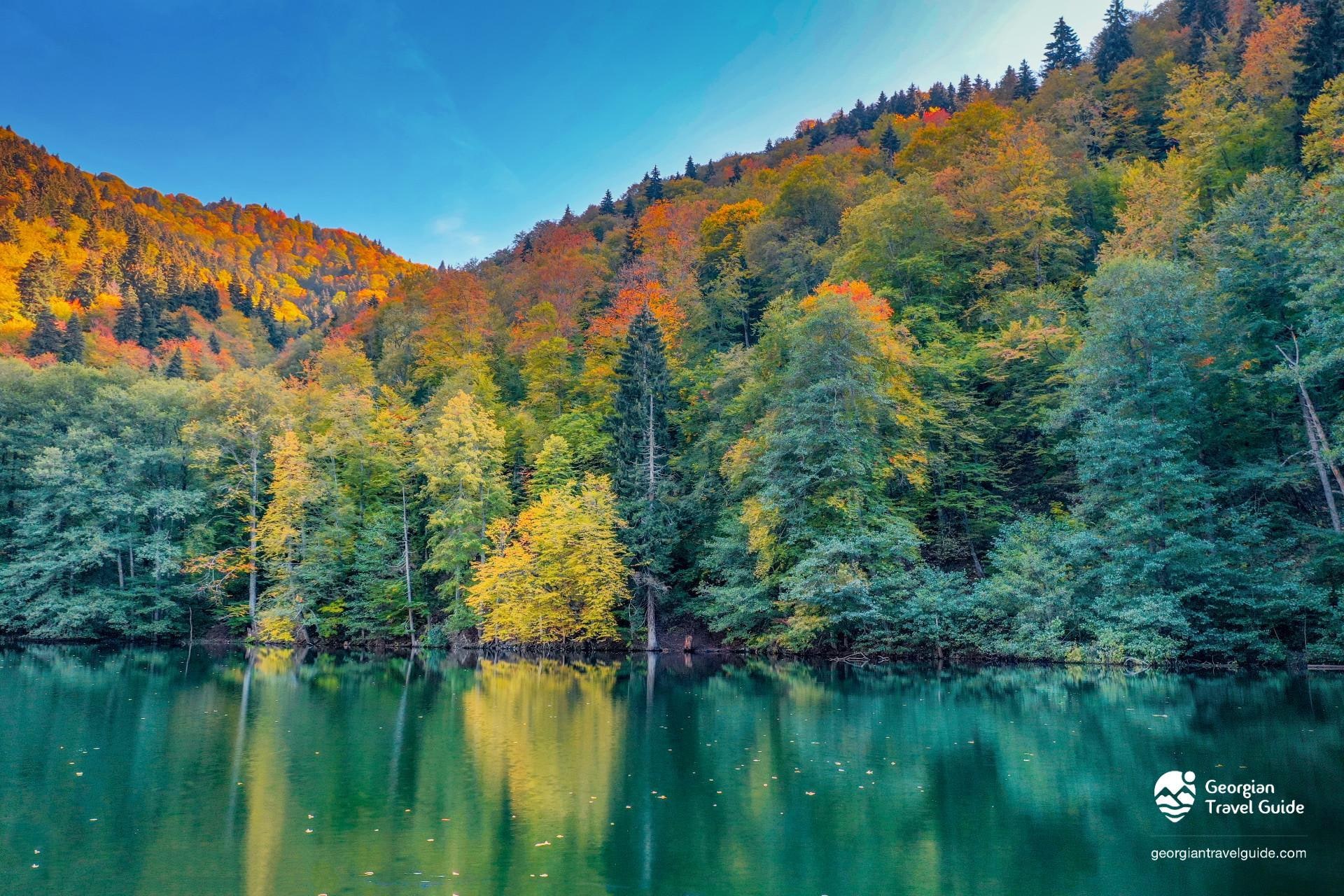
One of the most beautiful natural places in the region, about 23 kilometers from Kareli, in the middle of a forest. From the end of the road to the lake it is about three kilometers on foot.
The lake is small, with an area of about 0.02 km², formed as a result of a landslide, the maximum depth reaches 12 meters. Swimming and fishing are prohibited here, but the place is great for a walk and a picnic.
This is a natural area - you need to take your trash with you.
Apple edge
Shida Kartli is the main apple producer in Georgia; gardens are concentrated in the Gori and Karelian regions. According to Geostat data for 2025, the region harvested 48.8 thousand tons of apples, with a total national harvest of 62.9 thousand tons - that is, about three-quarters of the national production.
A significant part of the harvest is exported: in the year since August 2025, Georgia exported more than 24 thousand tons of apples, and the vast majority went to one market. For local farms, this means that the price depends on things that they do not influence - exactly the same story as small producers throughout the country.
Therefore, during the season, local markets are a separate way to get to know the region: not only wine is interesting there, but also fresh fruit, processed products and seasonal goods.
What to try
Kartlian cuisine is known to foreigners less than Kakheti or Adjarian, and this has a plus: the dishes are perceived as part of ordinary local life, and not as a tourist menu. Among those characteristic of the region:
- sorrel dishes and matsoni soups;
- local cheeses and Kartlian wines.Suramistands on the western border of the region, on the old route through the Likhsky ridge. The main attraction is the Surami fortress, the exact date of its foundation is unknown: some sources attribute it to antiquity, others to the late Middle Ages. There is no point in repeating a popular date as an established fact. But the knowledge here is completely specific and has long become the gastronomic calling card of the road.
What to take on a trip
Gori is eighty kilometers from Tbilisi, so you can get ready in the morning of the same day. What's really useful:Uplistsikhe and the fortress.Powerbank - navigation on rural roads drains the phone quickly, and on a rocky complex the phone also works as a camera for a couple of hours straight.Ateni and the trail to Biisi.Thermos and light raincoat: in the valley the weather changes faster than in Tbilisi.Bateti Lake.This is the very format for which it is worth packing a normal picnic: folding chair, thermos, churchkhela and honey - something that does not require refrigeration or preparation. There is no cafe on the shore.
The rest of the equipment is in the section "Tourism Goods".
When to go
-April–May— Gori, monasteries, Uplistsikhe, walks;
-June–August— mountain valleys, waterfalls, Lake Bateti;
-September–October– wineries, gardens, gastronomy;
-late autumn- museums, architecture, historical routes;
-winter- Gori, museums, monasteries; Some of the natural routes depend on the weather.
For natural routes, seasonality is more important than the calendar: the road to Lake Bateti includes a walking section, and the condition of the trails changes after precipitation.
Ready routesOne day.Tbilisi → Gori → Gori Fortress → Uplistsikhe → Aten Zion → Tbilisi. The most intense option for a first acquaintance.History and wine.Tbilisi → Gori → Uplistsikhe → Ateni → winery → Gori or Tbilisi. For those who are more interested in culture and gastronomy than long walks.Nature for two days.Day one - Gori, Ateni, Biisi. Day two - Kareli, Kintsvisi, Dzama Valley, Lake Bateti. It’s calmer and without spending the whole day in the car.
The road from Tbilisi through Gori and Khashuri leads further to Samtskhe-Javakheti, so it is convenient to combine the two regions into one trip.
Geography and security
Part of the historical territory of Shida Kartli - the Tskhinvali region - is outside the control of the Georgian authorities and does not belong to ordinary tourist routes.
The rule of thumb is simple:do not approach the administrative boundary line on your ownand do not plan to cross in unprepared areas. The line is not always marked on the ground, and arrests do happen.
Gori and the main facilities around it are located in areas accessible for regular travel. But if the route goes to border areas, rely on the current recommendations of local authorities, and not on the map in the navigator.
Briefly
- Gori, 80 km from Tbilisi - a one-day trip, without an overnight stay.
- Uplistsikhe is mandatory if time is short; shoes are more important there than a camera.
- In Shida Kartli, try Chinuri, Goruli Mtsvane and Tavkveri - varieties that are not found in Kakheti.
- Lake Bateti - three kilometers on foot and no infrastructure; Bring a picnic with you.
- Do not approach the administrative demarcation line on your own.
What to see in the capital between trips - in the guide to Tbilisi.Sources: geostat.ge (final census data 2024, apple production 2025); georgia.travel (Gori, Uplistsikhe, Ateni, Dzama Valley, Lake Bateti, Surami); National Wine Agency of Georgia (Kartli zone, varieties, Atenuri).