Churchkhela is Georgia's most recognizable food gift. It's sold at every market and along every highway, but the quality varies a lot. Here's how to spot a good one, how to store it and how to get it home. Plus a word on its lesser-known cousin: tklapi, Georgian fruit leather.
How churchkhela is made
Nuts are threaded onto a string and dipped again and again into thickened grape juice, which is cooked down with flour until it's as thick as custard. Between dips, each layer dries a little, and layer by layer a dense coating builds up around the nuts. The strings are then dried for several weeks. Because of the flour in the coating, churchkhela contains gluten, which matters if you need to avoid it.
Churchkhela is made in autumn, after rtveli (the grape harvest), when there's plenty of juice. So the freshest churchkhela shows up toward the end of autumn.
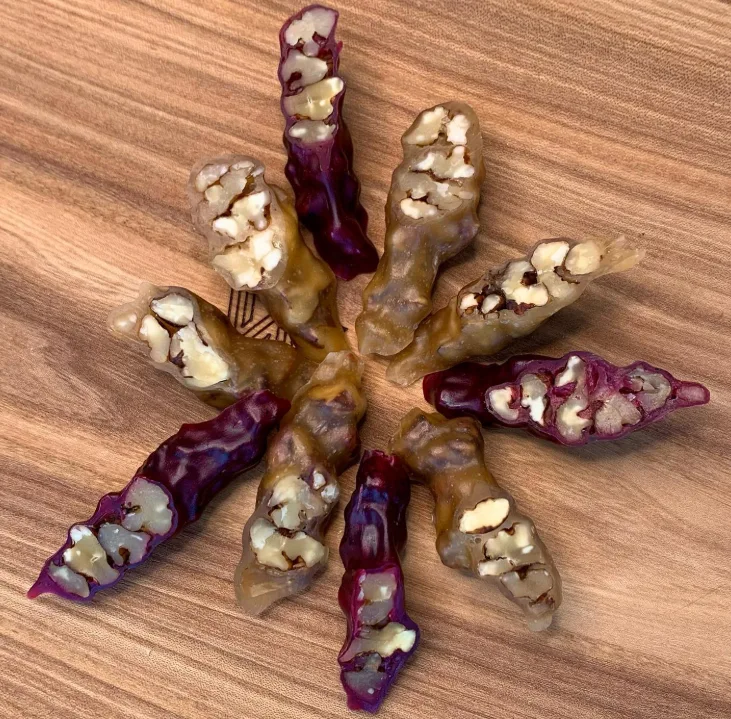
Kakhetian and Imeretian churchkhela
Kakheti is Georgia's main wine region, and churchkhela there is traditionally made with walnuts. In Imereti, it's often made with hazelnuts.
- Kakheti churchkhela with walnut — the classic, and a good place to start.
- Imereti churchkhela with hazelnut in a gift box — a ready-made gift, no wrapping needed.
Can't decide? Get both and compare: the nut changes the taste more than you'd think.
How to choose good churchkhela
- It bends. Fresh churchkhela is firm but flexible. If it's stiff as a stick, it has dried out.
- Lots of nuts. The coating is even, with no gaps, and you can feel nuts along the whole length.
- A matte surface. A light whitish bloom is usually flour or sugar that has come to the surface. But fuzzy spots, mold or a sour smell mean you shouldn't eat it.
- A natural color. The color depends on the grape variety, from golden brown to deep burgundy. An unnaturally bright color is a warning sign.
How to store it
- In a cool, dry place, out of direct sunlight.
- Wrapped in paper or linen. In a tightly sealed bag, churchkhela can get damp.
- For longer storage, in the fridge, wrapped in paper.
For the shelf life of a particular churchkhela, check its label.
What is tklapi?
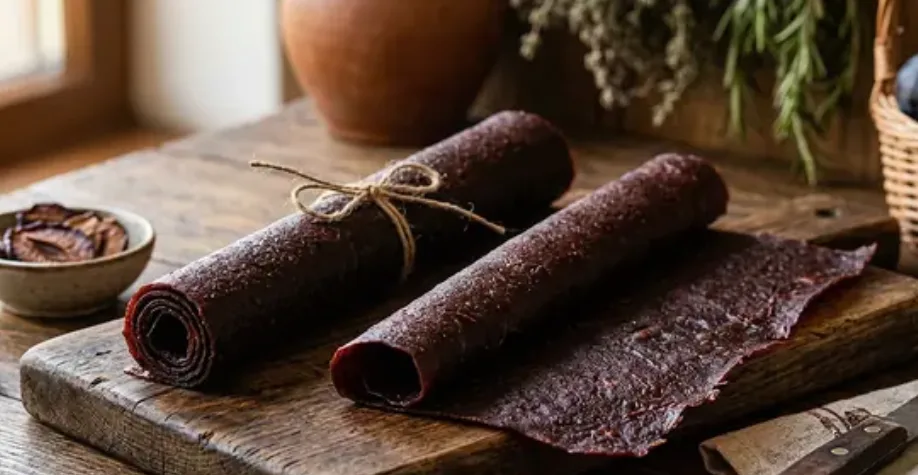
Tklapi is a thin fruit leather, or pastila. A purée of plums, cherry plums or other fruit is spread thin and dried in the sun into flexible sheets. There are two kinds of tklapi, and they're used in completely different ways.
- Sweet: with tea, as a dessert or a snack. For example, Kartli prune pastila.
- Sour: for cooking. Imereti tkemali pastila is what you need for kharcho: it's soaked in the broth and gives the soup its signature tang. Without it, kharcho is a completely different dish.
If you cook Georgian food at home, sour tklapi is one thing that's hard to find outside Georgia. The same plum is used for tkemali sauce; more on that in our article on Svan salt, adjika and tkemali.
How to get it home
Churchkhela and tklapi are about the easiest things to travel with. They're not liquids, so you can take them in your carry-on. A few tips:
- keep churchkhela away from heavy items and jars: it won't break, but it can get squashed;
- in hot weather, don't leave it in a car in the sun, or the coating will soften and stick to the packaging;
- check your destination country's food import rules in advance.
We've gathered other gifts that travel well in our article “What to bring back from Georgia as gifts”. And on a hike, churchkhela makes a filling snack that doesn't need a fridge.
In short
- Churchkhela is nuts coated in thickened grape juice. Kakhetian is usually made with walnuts, Imeretian with hazelnuts.
- Good churchkhela is flexible, with an even coating and plenty of nuts.
- Store it in paper in a cool, dry place; for longer storage, in the fridge.
- Tklapi comes sweet (for tea) and sour (for kharcho).
- Both churchkhela and tklapi can go in your carry-on.