A first night in the mountains most often goes wrong not because of the route, but because of the cold: a sleeping bag “rated to minus five” that really only keeps you warm down to plus five, and a thin mat that lets the ground drain away your body heat. Here's how to choose the three key items without paying for things you don't need.
Where you can legally camp near Tbilisi is covered in our guide to hiking around Tbilisi. This article is just about gear.
Tent: size up by one person
The number on a tent is how many people fit inside lying down, shoulder to shoulder. Backpacks, boots and a wet jacket aren't part of that number.
- Going solo? A 1–2 person tent leaves room for your gear inside.
- Going as a pair? Take a 2–3 person tent: two people won't feel cramped, and you won't have to leave your backpacks out in the vestibule.
What else to check on the product page:
- Weight. If it's a few hours' walk to camp, you'll feel every kilogram.
- Fly waterproofing. It's given in millimeters of water column: the higher the number, the heavier and longer the rain the fly can take.
- Two layers. An inner tent plus an outer fly handle condensation better, so it's drier inside in the morning.
Before your first trip, pitch the tent at home or in the yard. Figuring out the poles for the first time in the dark and wind is a bad idea.
Sleeping bag: go by the comfort temperature
Sleeping bags usually list three temperatures:
- comfort — you sleep well without curling up into a ball;
- limit — you can get through the night curled up without getting seriously cold;
- extreme — a temperature for survival, not for sleep.
Choose by the comfort rating and compare it with the overnight forecast for where you'll camp, not for Tbilisi: at fifteen hundred meters, nights are noticeably colder than in the city. A three-season sleeping bag works for most nights out from late spring to early autumn, but check its comfort temperature against the forecast too: in the mountains, nights in April and October can drop below freezing.
Sleep in dry clothes. What you hiked in during the day is damp by evening and pulls heat away. Keep a separate set for sleeping, such as thermal underwear.
Mat: the cold comes from the ground
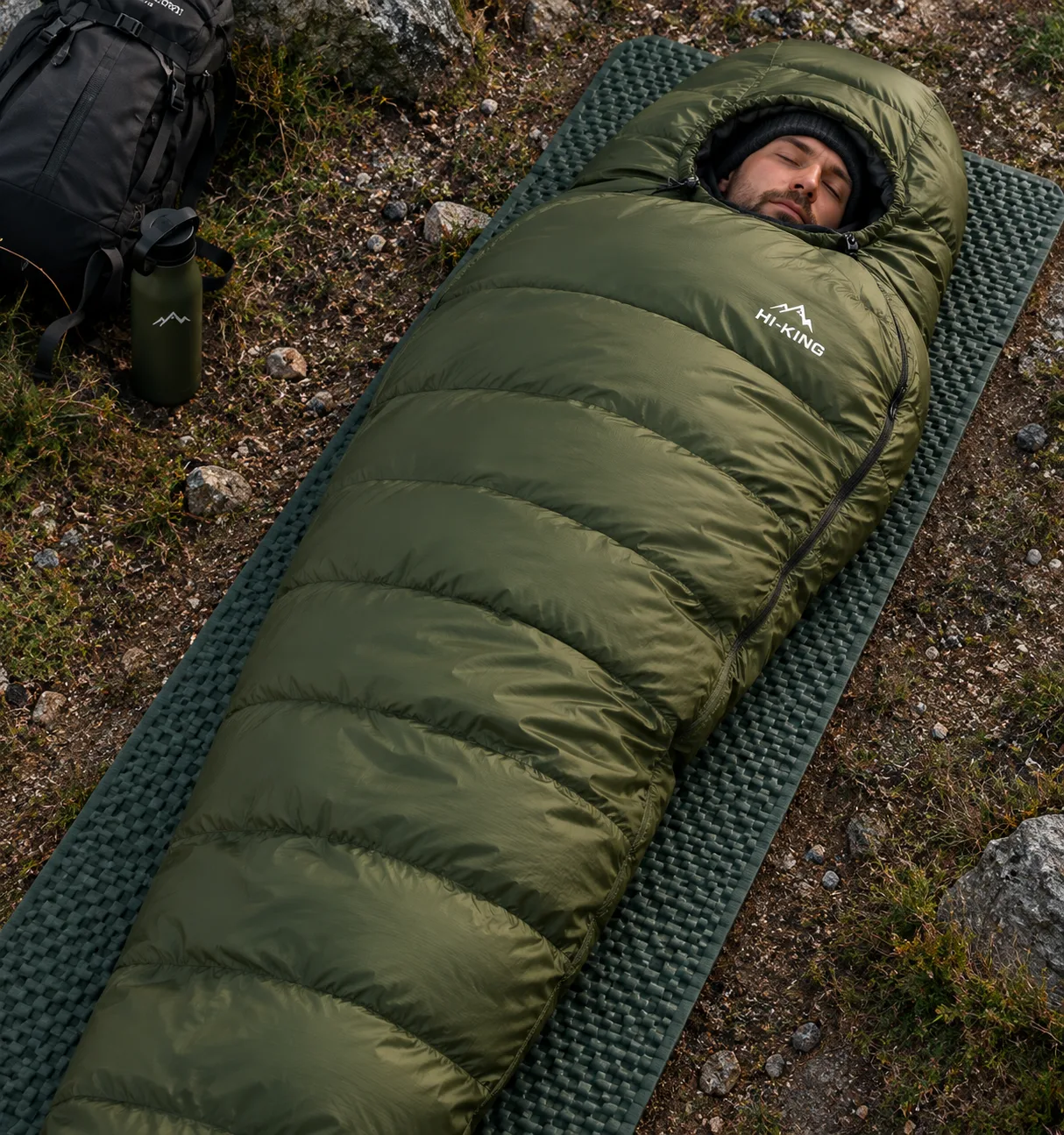
The sleeping bag gets squashed under you and barely insulates, so only the mat protects you from the cold ground. That's why even a warm sleeping bag on a thin mat means a cold night.
Some mats list an R-value: the higher it is, the better the mat insulates. A low value is enough in summer; in spring and autumn you need more.
An EVA foam mat (it's listed on our site as a yoga mat) is light and, unlike an inflatable one, can't be punctured. Check the thickness on the product page: if the mat is thin, double it up in the mountains or put spare clothes under it, even in summer, since nights at altitude are cold.
Put the mat directly under your sleeping bag, not next to it. And don't forget a camping pillow: a rolled-up jacket slips away by morning, and your neck will let you know.
Stove and gas: buy locally
Gas canisters can't be taken on a plane, in either carry-on or checked baggage. If you've flown to Georgia with your own stove, you'll still need to buy gas here.
The key thing is the connection type: it varies between stoves and canisters, and the wrong canister simply won't screw on. Check it on your stove and on the gas canister product page before you buy, not at camp.
And bring a thermos: hot tea in the evening and morning saves both gas and time.
What else to pack
- A sturdy raincoat for long, steady rain: in wet clothes, a night in a tent is a long one.
- A power bank, since phones drain faster in the cold. We cover which one to choose in a separate article.
- A headlamp, a first aid kit, extra water and a trash bag, so you can carry out everything you brought in.
All the gear in this article is in our “Outdoor gear” section, with delivery within Tbilisi. The delivery time is shown on each product page: if you're heading out on Saturday, check it in advance.
In short
- Get a tent for one more person than you have: your gear needs space too.
- Choose a sleeping bag by its comfort temperature and the forecast at altitude, not in the city.
- No sleeping bag will keep you warm without a mat: the cold comes from the ground.
- Gas can't go on a plane, so buy it locally and check that the connection type matches your stove.
- Pitch your tent once at home before your first trip.